


100 days: Largest Wash. Trump donor, from Fairhaven, likes what he sees
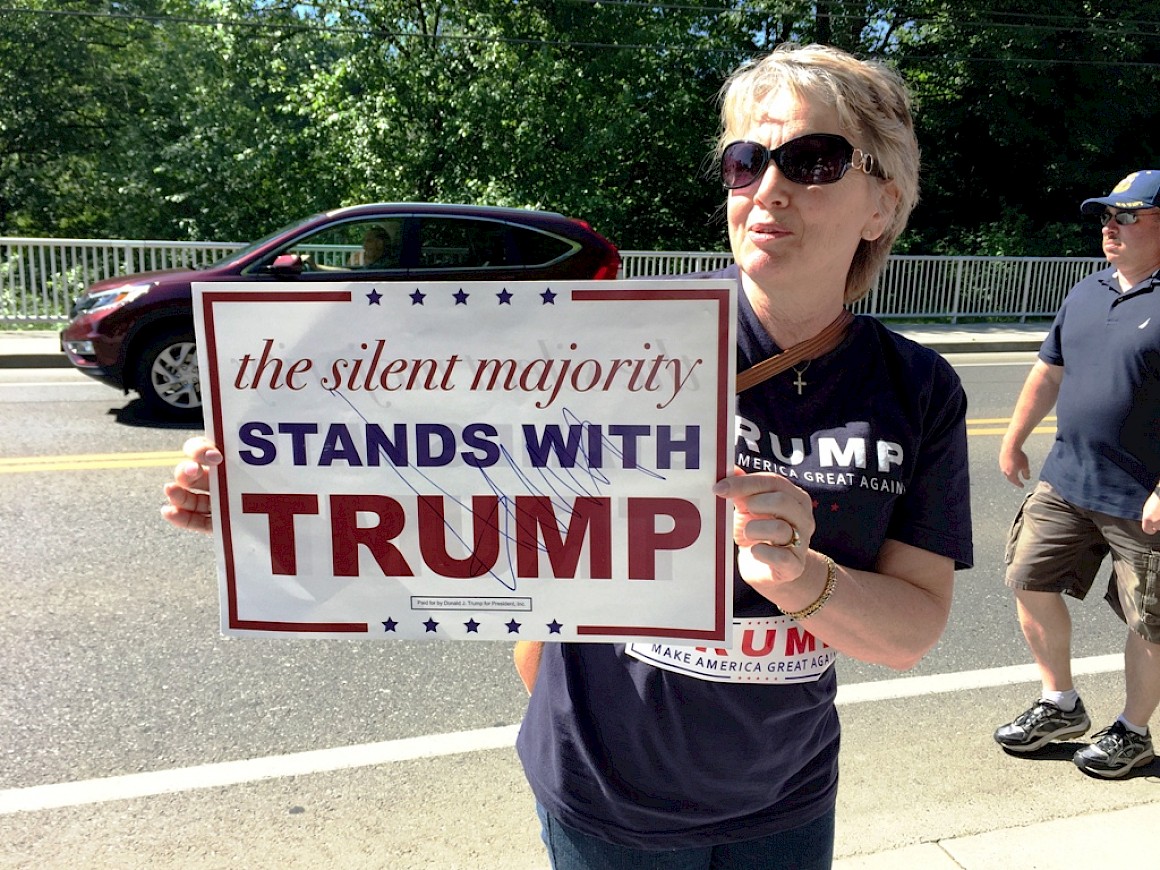
A Donald Trump supporter shows off an autographed sign on May 7, 2016, to people waiting along Kok Road, Lynden, for the start of Trump's campaign rally in that city. .

100 days: Largest Wash. Trump donor, from Fairhaven, likes what he sees
100 days: Largest Wash. Trump donor, from Fairhaven, likes what he sees

Not one to shy away from a media cliche, I followed up with Peter Gigante on the occasion of Donald Trump’s 100th day in the White House.
OK, so I’m four days late.
Gigante’s claim to fame is this: He was the single largest donor from Washington state to Trump’s presidential campaign, having given multiple times for a total of $3,200. He actually tried to give more—the campaign returned most of a $10,000 donation Gigante had made because it exceeded the maximum amount allowed by federal elections law.
I interviewed Gigante at his Fairhaven condominium in January, two weeks before Inauguration Day, to ask him what he liked about Trump to offer his campaign more money than anyone else in the state.
The answer, in a word, was China. Gigante is something of an expert on U.S.-China trade relations. He spent eight years in China, as a developer and an importer. After he moved to Bellingham in 2010, his business was exporting Alaskan fish and timber to China.
Trump vowed during his campaign to get tough with China. He said he would brand the country as a currency manipulator on his first day in office and impose tariffs of up to 45 percent on Chinese goods entering the U.S. The media had said these promises amounted to a trade war, something Gigante and I discussed in January.
“China has had 30 percent tariffs and value-added taxes on our goods for the last 25 years, against our 0 to 2 percent tariffs on theirs,” Gigante said on Jan. 6. “If we level the playing field how is that starting a trade war? The Chinese have been in a trade war with us for the last 20 years, we just don’t know it.”
After taking office, Trump decided not to accuse China of devaluing its currency to gain an unfair trade advantage. As The Washington Post reported last month, economists say the opposite has been true of late—Chinese leaders have been intervening in the currency markets to prop up the value of the yuan, which helps American exporters.
Nevertheless, the United Steelworkers were unhappy with Trump’s reversal on currency manipulation. Trump’s softening stance on trade with China appears to be a bargaining chip the president is using to get China to put pressure on North Korea to stop developing its nuclear weapons program.
“Workers are still not interested in having their jobs used to incent China to help deal with the nuclear threat of North Korea,” read a USW statement from April 13, as reported in the Pittsburgh Post-Gazette. “The president’s recent statements send a signal that he may be just another politician saying one thing to get elected and doing something else once in office.”
In a series of emails Gigante and I exchanged in April, I shared several news items with him, including the above USW statement, as we looked forward to his assessment of Trump on China at the 100-day mark.
Here are the questions I sent Gigante, followed by his answers. Both are complete and unedited:
Me:
1) You supported Trump and in fact were the largest single donor to his campaign from Washington state, largely due to his promise to get tough with China on trade in order to benefit the American worker. Since Trump’s inauguration, steelworkers have expressed concern he isn’t following through on his promise, and he did reverse himself on his position that China manipulates its currency to gain a trade advantage. What has your reaction been to Trump’s first 100 days, with respect to China?
2) Are there any other observations you would like to make about the first 100 days of the Trump administration?
Gigante:
Naming China a currency manipulator would bring the WTO into things. It’s best if we handle our differences with China bilaterally or unilaterally if need be.
I trust Trump to peel the onion and negotiate methodically and comprehensively with China while keeping the American worker at heart. This takes time.
Dealing with Korea first makes sense. Security should come before trade.
When the appropriate time comes the many inequities in our trade relationship with China will be dealt with—import tax differentials, forced technology transfers, market access and currency valuation. The RMB (renminbi, which is the name of the Chinese currency. A yuan is one unit of that currency-RS) is being valued by the market and by the Chinese people themselves as a highly risky currency to hold because of the lack of rule of law in China, a judiciary that is not independent and the arbitrary nature of China’s authoritarian one party system. Currently the United States is subsidizing the success of this type of system through job losses and lower wages and the increased wealth in China has not resulted in hoped for democratic reform. In the process we are ceding economic and military dominance to an increasingly assertive and nationalistic China, and the market share our businesses are getting in return in China will begin to evaporate as China strengthens further and begins to assert highly discriminatory treatment in favor of Chinese entities. At that point, perhaps in 10 years time, it will be game over. We need to act.
Globalization and free, open trade are beneficial and necessary, but FAIR trade should be a precondition.
I trust Trump to address these issues at the right time in the right way. He’s been talking passionately about trade for 30 years. He will navigate the issue properly.
Wait and see.


11 Comments