
Political Ethics
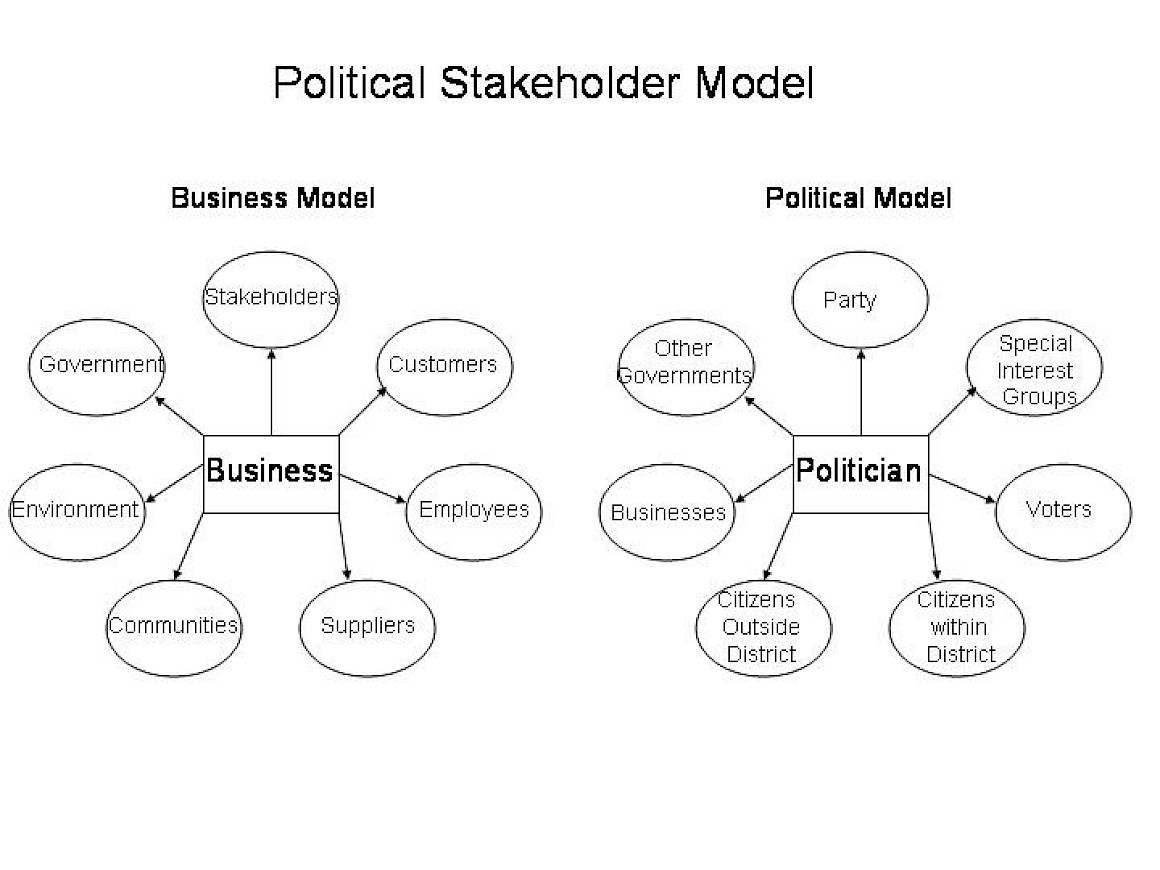
The Political Stakeholder Model .
Political Ethics
Political Ethics
The Political Stakeholder Model .


Craig,
I think it is naive to expect business institutions whose strongest motivation (as you point out) is profit to act ethically without strong regulation. Your stakeholder model is interesting, but business only considers stakeholders insofar as they affect profit - a business may regard customers as stakeholders but pleases them only in order to increase profits.
This is a stark statement of American capitalism, one which in my experience is widely held to be true. It is based on desire for profit, otherwise known as greed.
I know of no ethical system, nor religion (religions comprise the majority of ethical systems subscribed to by humans) which considers greed to be virtuous. On the contrary, ALL the monotheistic religions (Christianity, Islam, and Judaism) have multiple laws and injunctions against greed, usury, wealth accumulation for its own sake, and so on. Some Christian scripture: “it is harder for a rich man to enter the kingdom of heaven than for a camel to pas through the eye of a needle”; “forgive us our debts, as we forgive our debtors”; “blessed are the meek, for they shall inherit the earth”. Moreover, the Bible is quite clear that there should be a regular “Jubilee”, a festival when all debts are forgiven. The year 2000 should have been a Jubilee year; instead we got the orgy of corruption, greed, and unjust dominion which was the Bush administration, and we now are living with the consequences: an economy laid waste by greed and irresponsibility, supported by induced fear and war hysteria. And all for the profit of the greedy few.
This institutionalized greed is also, in my opinion, the source of the corruption in the federal government. Thie interests of the people are secondary to the moneyed corporate interests to which our “representatives” are beholden for the money which buys them their sinecures. The entire apparatus is corrupted by this dynamic.
I admit to disgust and fear at a federal government run amuck, but I have few solutions other than to stop supporting it. Vote with your dollars - why pay to watch the corporatist propaganda which infects the public airwaves? Why slave away to pay federal taxes and support the corrupt machine? Why put your trust in that which has clearly been taken over by interests hostile to yours?
Wherefore is Babylon to be found?

Whenever this conversation (frequently) comes up, I always try to refer folks to the Mondragon Cooperative Corporation.
Their model keeps capital subservient to the public good with education and employment at the core.
Gee, maybe that’s godless communism, but maybe not. They have transformed the Basque region of Spain from the poorest areas in Europe to one of the wealthiest. They have some of the best health and welfare programs. They hew to equitable principals - the average wage disparity between workers being 5:1. Management is rotated through the ranks. Business is built from stable sub-assemblies, lending flexibility and endurance to the system.
It’s an excellent model of alternative economics, but one which fails to get any traction in so-called capitalist (corporate welfare) states. Obama’s bailout could have initiated community structures like the Mondragons employed to drag themselves out of abject poverty. If the bailout had been distributed to communities on a population basis, Whatcom County would have received over $520 million for deposit, creating a lending capacity over $3 billion. We could have fixed our local economies and let the big banks fend for themselves.
Now they are posting record profits, still not loaning money, still selling bunk paper, and gearing up for big, big bonuses, again.
Oh well.

There is one important factor that I think makes business ethics and political ethics different. Customers can do IMMEDIATE damage to a company that they feel is acting poorly. They can stop buying their product tomorrow. Politicians often aren’t answerable for two, four or even six years later. This allows for plenty of time for the voters to forget, the special interests to be woo-ed, etc.
Look at the double stepping that Joe Lieberman can get away with, he isn’t up for reelection for another two years. Or Ben Nelson or Max Baucus. They are relying on the fact that no one will remember in two, four or six years.
On the other hand, when the politician IS immediately answerable, they tend to act more ethical. Still, it is very dicey.
This is why I am glad that Rob McKenna is looking into the unethical behavior of Ward Nelson in his quest for the appointment to Bob Kelly’s seat. We need accountability in all institutions, business or political.
David,
If you think about it, all regulation is the result of unethical behavior. If companies engage in unethical behavior, eventually people get frustrated and lobby their government officials to pass a law to stop the behavior. You are correct that the more unethical business becomes, the more regulation that be put into place. If businesses do not like the regulations, then act ethically in the first place.
Tip,
I knew you would bring up the Co-op model. I was going to mention it for you, but thought I would give you the honors.
Riley,
That is the reason it is easier for politicians to act unethically then businesses. Customers do have a more immediate response and if politicians engage in unethical behavior there is no one but the source of the problem to regulate the behavior, which obviously is not going to happen.
4 Comments