


City’s First Step to Rezone/Upzone Single Family Neighborhoods

.


City’s First Step to Rezone/Upzone Single Family Neighborhoods
City’s First Step to Rezone/Upzone Single Family Neighborhoods

The public process for amending the accessory dwelling unit (ADU) ordinance has been compromised by poor planning and lack of transparency in notifying the public. The city canceled a public hearing on the revised ordinance that had been scheduled before the Bellingham Planning Commission on December 7th. The new hearing has been moved to January 25th, however, the “Re-notice of Public Hearing” issued last week does not even mention the massive change proposed by the Planning Commission since it began its deliberations on the matter several months ago. The “re-notice” does not inform the public accurately about the hearing’s substantial change in purpose. Was this intentional or just a bureaucratic attempt to clean up an earlier mistake of inadequate notification? With a change of scope of this magnitude, the public needs a clear notice of intent.
The origin of this switch is that the commission unexpectedly asked staff to draft an ordinance for a wholesale rezone of all single family neighborhoods, in what Commissioner Maute-Gibson referred to as “a bold move,” to allow Detached Accessory Dwelling Units (DADUs) city-wide. Heretofore, DADUs have only been authorized under the city’s Infill Housing Toolkit that does not apply to single family zones. At the same meeting, there was also a discussion of reducing the minimum lot size required for DADUs (now at 10,000 sq ft) and minimizing setbacks while drastically diminishing the percentage of required green space; the “spare no tree” approach. Consequently, the city is about to renege on its commitment to neighborhoods that toolkit forms would be added only if the neighborhood submitted a proposal. What happened to neighborhood planning and neighborhood self-determination?
Moreover, missing in the discussions of the ADU ordinance, and the problem of affordable housing in general, is any discussion of measures regarding the outcomes of such zoning changes. What defines success? There has been no discussion at all about reviewing the ADU ordinance in 4, 5, or 6 years. The reason this has NOT happened is because the goals of these proposals have not been established nor has anyone taken the time to coherently present the measures of success. If you do not know where you are going, how do you expect to arrive?
There is also a failure to demonstrate where any proposals - ADUs, DADUs, town homes, duplexes, etc. - have already worked to actually LOWER housing prices or make lodging more affordable overall. If you work for minimum wage, it is of little importance that a Cadillac is less pricey than a Maserati. So let’s ask about affordability by asking who exactly is buying the town houses in the Fountain urban village on Peabody St. for $425,000. Surely it is not a single mother from Birchwood with three children who is working for minimum wage. Town houses on Cornwall Ave. are being sold at $325,000. Not much comfort for a family with an annual income of $50,000. And where is the flurry of construction of attached accessory dwelling units that have been authorized by code since at least 1995 in single family zones? Have homeowners been holding out for decades, waiting for the zoning to change just so they can build detached units at twice the price? (see below)
The city, and by extension the Planning Commission, has failed to make its case on affordability, pointing only to places that have adopted such zoning modifications and saying, “Well, CITY X did it, so should we.” We are not hearing that “City X has done it with great success! And here is the proof.” Prices are not going down, nor should we expect that they will go down regardless of how much is built in spite of the admonitions of the real estate and development community. ADUs and DADUs are not inexpensive to build. One need only look at the Portland experience where average construction price of an ADU, calculated several years ago, was about $45,000 and a DADU around $80-90,000. That these housing types remain affordable either for the owner or the tenant is just not demonstrable.
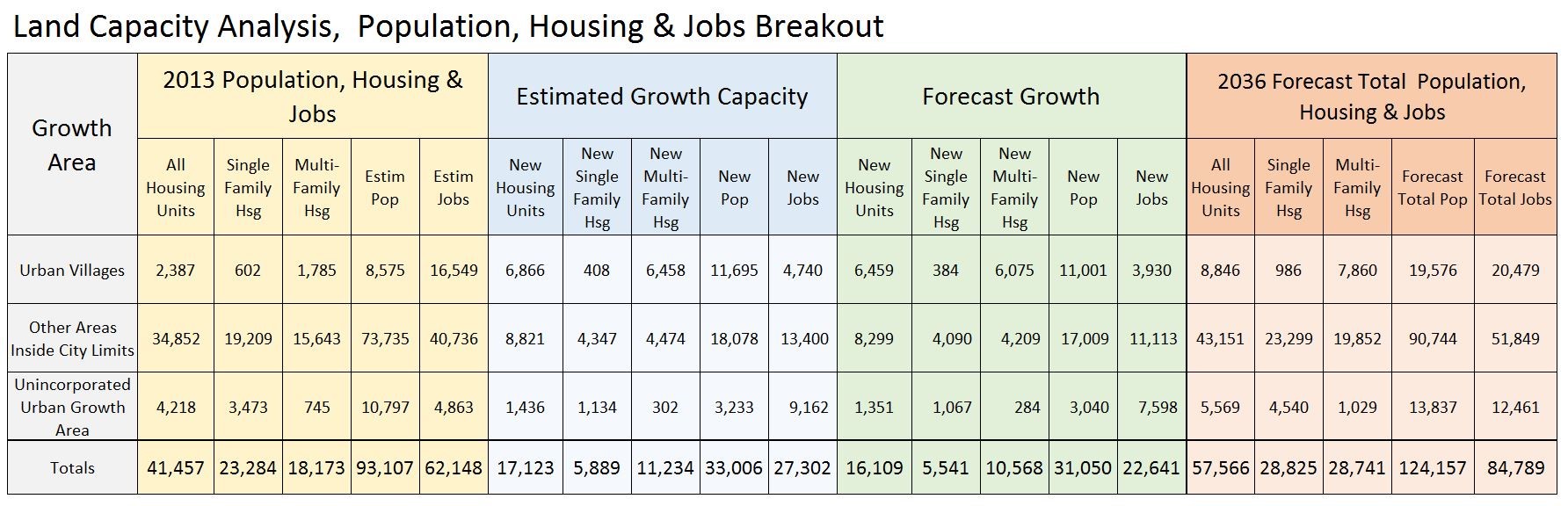
The city is approaching housing and affordability in a haphazard and disconnected manner. It is a piecemeal approach to growth planning that has no measurable goals and forces citizens to consider various solutions separately, as fragments without a cohesive element other than to build more of everything. Throw out the rules and densify, densify, densify in the name of an elusive affordability and equity that cannot be met by free market action because the free market has no interest in affordability and equity. The kicker is that a Bellingham land capacity analysis [click on chart at left above] demonstrates that without any changes to our land use, there is sufficient capacity for growth projections for the next 20 years.There is ample developable land already to accommodate affordable housing. Adding for land capacity won’t automatically create more housing capacity. Affordable housing, on the other hand, is guaranteed only by living wages, subsidies to individuals or families, public housing or rent controls. Anything else is a gift to those who profit from development. No coastal city in the entire U.S. with a strong economy and satisfactory quality of life has been able to provide affordable housing. [See Affordable Housing. Mission Impossible? and Myths Around Affordable Housing in Bellingham]


5 Comments